Friday, December 30, 2011

Sharp!

A chef's most important tool is a knife.  There are many kinds of knives, each with their own special job:

boning knife - for boning say a chicken
chef's knife - for pretty much every job
filet knife - fileting fish, fine cutting
paring knife - fine cutting, small cuts
carving knife - for carving meats
sashimi knife - for cutting thin pieces of fresh fish


Left to right: paring knife, boning knife, chef knife, carving knife, filet knife, serrated knife.

There are many more kinds of knives but the above knives can all be found in my collection.

The other most important knife is a SHARP knife.  I know, I know, most people are afraid of a sharp knife, they think they will cut themselves.  Well I have news for you, you are more likely to cut yourself with a dull knife than a sharp knife.  Why you say?  Think about cutting into a lemon, a dull knife will slip off that thick rind, a sharp knife will grab and cut right away, quickly and cleanly.  Even if you cut yourself with a sharp knife, it's a clean fine cut that heals cleanly and quickly, a cut from a dull knife results in an ugly cut that will leave a scar and take a long time to heal.  Then there is the tomato, ever tried to saw through a tomato with a dull knife...a sharp knife will leave a clean cut, no damage to the fruit whatsoever.  A sharp knife makes a lot of work go faster and believe it or not, less tears from cutting an onion.

I'm sure most people wonder how to keep their knives sharp or how to take those dull 'knives' in their drawers sharp.  There are places to take your knives to bring back the edge if they are really bad, I go to a place called Knife (www.knifetoronto.com).  Those guys love a sharp knife.  

In November I took a knife sharpening class, just to see how much better I can do with sharpening my knives.  So here's the scoop:  buy yourselves 2 sharpening stones a 1000 grit and a 4000 grit, you can buy these online from Lee Valley or when you drop in at Knife you can buy your stones there, they may seem expensive but will last you pretty much forever, so it's a great investment.


Left to right: 1000 grit and 4000 grit

Wet your Whetstone, 1000 grit, take 3 pennies and lay the knife on an angle and that will determine the angle to sharpen:


Sharpen following the curve of the blade, if you are right handed 70% of the sharpening should be on the right side.

For the other side of the knife, use 2 pennies to determine the angle:


Polish using the 4000 stone the same way as above.  VOILA!  If you just polish with the 4000 stone once or twice a week you will never have a dull knife and a sharp knife makes life so much easier.


Sunday, November 20, 2011

SMOKIN'

I learned how to cure and smoke my own bacon.  Yup, the food of the gods...BACON.


For those of you who don't like bacon, well honestly, I'm really sorry, really, really sorry.  So along with my bacon I decided to throw on a few beef short ribs...hehe

So why do we smoke food?  Besides the obvious - taste - it's a really old way of food preservation.  The meat is cured in salt and possibly spices, and other flavours, then smoked to dry out the meat.  There are 2 ways to smoke - hot and cold.

Hot smoke:

Hot smoking exposes the foods to smoke and heat in a controlled environment. Although foods that have been hot smoked are often reheated or cooked, they are typically safe to eat without further cooking. Hot smoking occurs within the range of 165 °F (74 °C) to 185 °F (85 °C). Within this temperature range, foods are fully cooked, moist, and flavorful. If the smoker is allowed to get hotter than 185 °F (85 °C), the foods will shrink excessively, buckle, or even split. Smoking at high temperatures also reduces yield, as both moisture and fat are "cooked" away. (http://en.wikipedia.org/wiki/Smoking_%28cooking%29)

Cold Smoke:

Cold smoking can be used as a flavor enhancer. The item can be cold smoked for just long enough to give some flavor. Smokehouse temperatures for cold smoking are below 100 °F (38 °C). In this temperature range, foods take on a smoked flavor, but remain relatively moist. Cold smoking does not cook foods. (http://en.wikipedia.org/wiki/Smoking_%28cooking%29)


 Last week I hot smoked a pork belly in maple smoke - yummy.  Today I did a cold smoke.  It took 1 week to cure the pork and 6 weeks to smoke it.  It also took about 1/2 pound of charcoal, 1/2 pound of maple chips and a whole lot of cherry wood.  The wood is all soaked in water so it smokes rather than burns and you have to keep a pretty close eye on the entire process.  I checked every 30-60 minutes.  It was actually fun tweaking the chimney on the smoker to control the heat and finally, it was done - and it was yummy.

Most of the bacon is going into the freezer because there is a lot of it.  The short ribs will go in the pressure cooker tomorrow night and I'll call that dinner!

So why am I so excited about having smoked my own bacon?  Well it certainly doesn't taste like the saline laden stuff in the grocery store!  No nitrates.  What are nitrates, well: in this day and age, it's mostly for preservation of colour.  I plan on freezing my bacon and cooking it before I eat it, so there's no worries of any kind of spoilage happening.  Nitrates are not good for us, they are a proven cancer causer, and I know there are enough other chemicals around us that cause us cancer, this is one less.  Most grocery store bacons are heavy in saline solution so you are paying for water weight that gets cooked out.  When I fry up my bacon, there is no water in the pan (just the fat).  So here is the story in pictures:

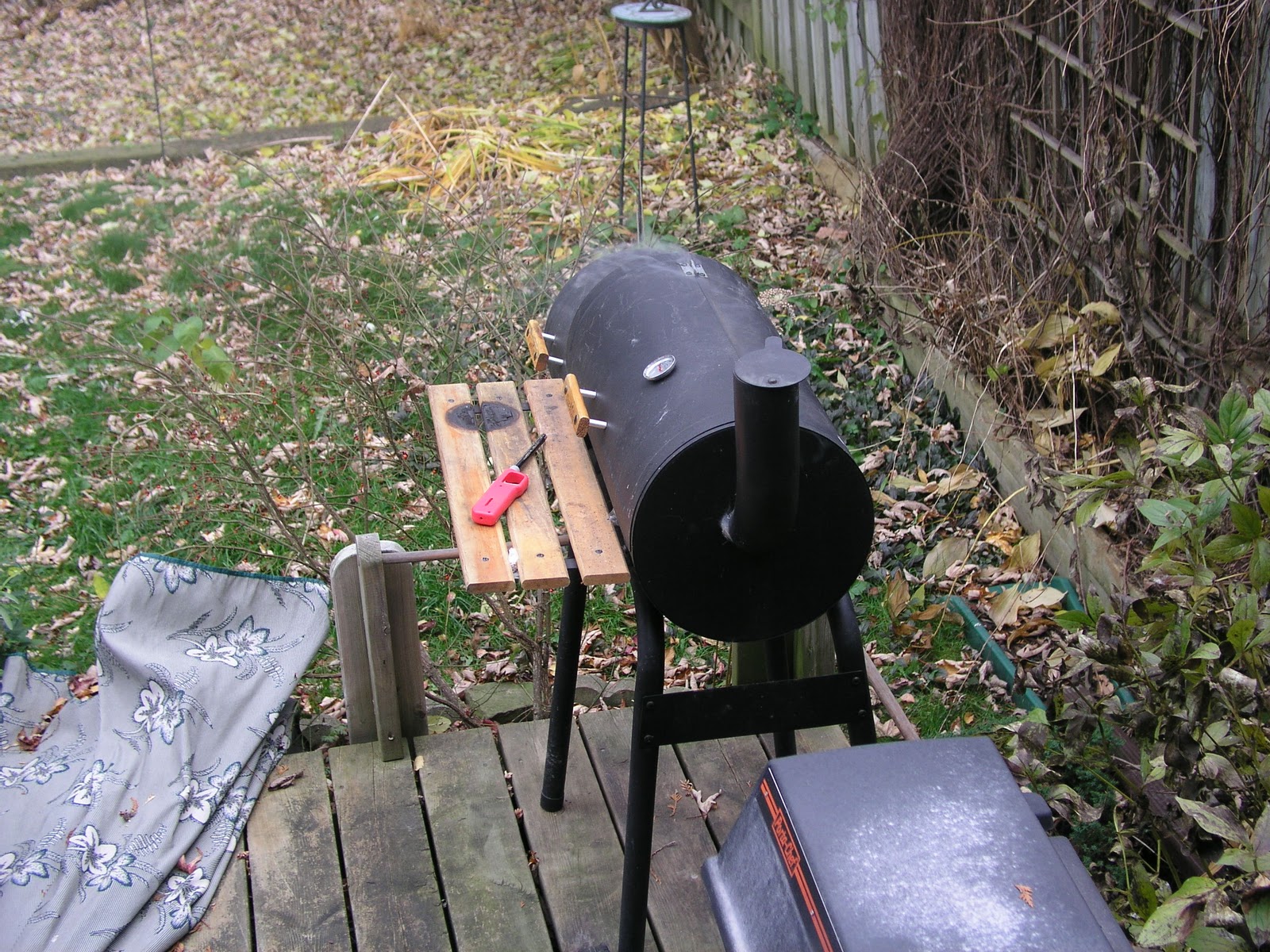
My lil' ol' smoker

Maple chips soaking

Cherry Wood Soaking


Short Ribs from the butcher shop before...

 Pork Bellies just starting to smoke

The lovely hot box filled with cherry wood

Short Ribs 2 hours in

The smoker - smokin'

After 6 hours

The finished bacon (and it was awesome)

Sunday, October 30, 2011

What exactly is charcutiere?

I'm starting a new professional cooking class next week - Butchery and Charcutiere.  Many of you may know that I worked as a butcher for 2 years and loved it.  Alas, I never was able to talk the owners  of the butcher shop into letting me make artisan Charcutiere.

It took me 5 minutes searching the web to figure out how to spell the word, so what exactly is it?  It's a general term for prepared meats, pates, terrines, foie gras, pickled vegetables, dried fruits and cheeses.  It's such a huge subject that the region I want to concentrate is Alsace, France.  Why that region of France? My ancestors on my dad's side come from there and I love that style of food, lots of beer, lots of sausage and foie gras, potatoes and cabbage!  Great food for our climate from October to April.


This is a veggie terrine that I made years ago with spinach, roasted red pepper and butternut squash.


This is a chicken pate en croute - it is a pate baked inside pastry and is heavenly!

I'm sure there will be a lot of fun stories coming from my new class and a lot of my followers will be able to sample, simply because what I make I can't possibly eat all myself.  

A little history?  Alsace has been passed back and forth between Germany and France for centuries.  It is on the border to Germany and after the end of WWII Germany had to hand it over to France once again.

To ease you guys into the joys of "Alsatian" cuisine, here's my favourite recipe that I'm going to make for dinner tonight.  This recipe has just a few ingredients and is super easy to make.

Braised Pork Belly - Serves 4

6 lbs of Pork Belly
Apple Cider
Caraway Seed
1 large onion, sliced
2 apples, peeled, cored and sliced
White vinegar
salt and pepper

Preheat oven to 250 F.  Put pork belly, fat side up in deep casserole pan.  Put in pan, around pork belly onion, apples and caraway seed, pour in enough apple cider and a couple splashes of vinegar (and maybe some of your favourite beer) so that liquid is 3/4 of the way up the side of the pork belly.  Cover with foil and put in oven for abut 4 hours.

After 4 hours remove from braising liquid (keep this!!!) and let sit for about 10-15 minutes.  After resting, cut into 2" x 2" pieces.  Heat broiler in oven.  Place pieces on cookie sheet and place under broiler to crisp up the top of the pork belly.

Serve over mashed potato or braised cabbage with the braising liquid and a large stein of dark beer!

Next week I hope to have pictures of my first day of class if it's not too gruesome...hehe!

Tuesday, October 25, 2011

Burgers

So the past 2 months I have been across Lake Ontario, flown to Las Vegas, driven to the Grand Canyon, Hoover Dam and the Windsor Casino.  It's been a fun couple of months and I finally found something worthy to write about.  BURGERS!!!

When I was in Las Vegas with my 3 girl pals, we had the best burgers ever!  This is the only story I can share from Vegas because technically we weren't in Vegas when we had our burgers...

We are driving back from the Grand Canyon in our Mustang Convertible, starving.  Hoping that the rumour is true that in Boulder City, Nevada there is a diner that was featured on Guy Fieri's Diners Drive-ins and Dives.  We pull into a side street, park the car and peel ourselves off the black vinyl seats.  We have no idea where we are...so I stop in a local real estate agent and ask some guy sitting in the waiting room if he knows what we are looking for.  Apparently the place closes after lunch and it's 5:30...Our stomachs growl in disappointment. 

Suddenly a cute blonde 20-something guy pops his head around the corner and directs us to the hole in the wall next door.  Apparently they have great food, and he gives us a raving review.  We bite.

Dillinger's it's called, in Boulder City, Nevada!  


It's small, nothing fancy, dark but quirky.  We pick a table near the front and are greeted by our waitress Amy, she was awesome:


On the menu tonight, well we want burgers.  There are a lot of burgers, but the patties are made fresh, and so are the buns and are toasted perfectly.  I go for the chili cheese burger (the chef boasts no beans in his chili because he doesn't like beans, me neither and in the immortal words of my travelling companion, what's wrong with beans is they get in your mouth...):


So Dawn chooses the pulled pork burger, even though she tells us she doesn't like bbq sauce...


Judy goes in for some kind of triple cheese thingie that dripped 3 kinds of cheese all over the place.


Terri went in for a Reuben on Sour Dough Bread, perfectly toasted.


Beers - a local gem but alas, I forget the name...but I loved it!  


Next time I'm in Vegas and get a chance for a side trip in the desert, I will make a point to go to Boulder City and have dinner at Dillingers - cheers for making great food to remember!!

On the flip side of the burger world is the most horrible "burger" my pal Terri and I had on our way to the Windsor Casino last weekend...I don't know why I wanted to stop for fast food, seemed appropriate, I hadn't had fast food in years, possible 10 or more years!  I totally regret it.

Let's start with the bread - white, soggy, tasteless, gluey.  The pattie - gray, dry, cooked from frozen, thin and tasteless, the tomato was under ripe, the tiny piece of onion, not even worth the effort, the pickles were at least something but they were drowned in the ketchup and mustard (I think I heard one of the pickles asking me to rescue it).  

People, why do we eat fast food WHY?  It's so not worth it when there are restaurants owned by regular people, rather than corporate America. Run by people who love their job, love to make people smile and care.  The fast food employees are there to make money, get home as soon as possible and their skills include opening plastic bags full of frozen burger patties, fries and emptying vats of ketchup into a large pump.

Taught me a lesson - no more fast food for me EVER!  Ask the locals if you don't know where to eat, apparently they don't lie...hehe


Monday, August 1, 2011

The Emerald Isle

I just came back from a place I never knew could exist in our modern, wasteful world.  I was in a place where there were no McDonald's, no Walmarts, no strip malls.  You can't just go to the grocery store and buy a TV dinner.  The crime rate is sooo low people don't lock their doors or their cars, and it's encouraged to pick up hitch hikers.  It's a place where restaurants are run by families, not corporations.  Their ingredients are from their own gardens, from the neighbours' chicken coops.  Everything is handmade, the bread, the roti at the People's Place and the fruit juice.  "Eat from the Land. Not from the Can" - small billboards read all over the island!

It's a place where you drive down the road and there isn't a stop sign or a stop light anywhere.  You can park pretty much anywhere without fear of getting a parking ticket.  Someone will politely ask you to move your car if it's in a bad spot.  It's where people live life, they embrace family and friends no matter if you are black, white, poor or rich or a tourist.  There isn't even a movie theatre, although John Watt's homemade ice cream is to die for!

There is no air conditioning and people are hang outside with friends and family - not locked in their 'castles'.  When you wave at people you don't get a blank stare, you get a wave back and a smile and most of the time a welcoming 'alrit mon'.  When someone beeps their horn, it's a friendly greeting or a form of a thank you.

It's a place where the environment rules the people, it's respected, it's enjoyed.  The watershed and rain forest are off limits to any kind of development and home to all kinds of unique birds, lizards, frogs, insects and plants found nowhere else.

Most of you know I just came back from Montserrat in the Lesser Antilles, about 48 kms southwest of Antigua.  It's the only island in the Caribbean with an active volcano and it's impressive!

I have been to a lot of places in the Caribbean and I have to say this is the first island where a natural disaster like the volcano stopped development for good and most of the locals are thankful.  Unfortunately 2/3s of the island are uninhabitable right now and the capital was buried under a pyroclastic flow in 1996 but they are slowly rebuilding.  There are problems with the roads and with the new airport.  The British government is slowly helping but can't be counted on.  I think this is a mistake as this seems like a perfect place to rebuild using our brains rather than our money.  To give priority to the natural world and our planet.  We might all well learn a thing or two about our greed and what it does to harm our planet.

So what did I do all week?  I made new friends, listened to local musicians, went to the Cudjoe Head festival, saw some of the devastation from the volcano, visited the Montserrat Volcano Observatory and drank in all the green, all the quiet, felt the peace, watched the boats go by and found a place where the smog, stress and anger of our modern world don't exist.  The history is rich and I want to learn more about slavery, the sugar trade and the volcano.  Thank you Montserrat!  I will be back!

 View from our villa

 Park anywhere

 Our fav eating place - The People's Place on Lawyer's Mountain - John is a total cool guy and a great chef!

 All roads are on a pretty steep angle, our driveway was about a 25 degree grade...

 Looking to the Northwest on the windward side of the island.

Montserrat at one time had a lot of Irish settlers and is nicknamed "The Other Emerald Island"


This is some of the new island created by the volcano!

There are more pictures on my Facebook page and a lot of pictures on Paul's computer, he's coming home tomorrow so check on Facebook later this week if you want to see more of Montserrat.  I can hardly wait to go back, hopefully for the St. Patrick's week celebrations - one week long party!

Sunday, July 17, 2011

ahhh Sailing!

It's Wednesday night, 10:06 p.m. and just off the race course.  WHAT A NIGHT.  There was 15+ knots of wind, off shore - meaning flat seas and a full moon.  Little Ashe had her storm jib on the front and a reef in her main.  There was no sitting and chatting or taking it easy for the crew or captain tonight!

We were right on at the start, 2 seconds late, not bad for a little boat and 4 chicks on board!  What a slog to the first mark, gusty as hell and fast, doing about 6 knots average and 3 tacks to the mark, the water rushing by and the sound of the wind never giving up.  The lake looked angry as the wind swept across the water and we worked little Ashe hard. The storm jib allowed for near perfect tacks.

The first down wind leg, we decided against the spinnaker, hell we were doing 6-7 knots dead down wind with very little sail up so there was no point.  We stormed down the course to the downwind mark, rounding the mark with our nemesis, Sierra Tango on the inside, giving them no mercy.  Upwind again 2 tacks to the mark, dodging a couple boat on starboard and we decided to toss up the spinnaker for the last leg of the race.  Unfortunately, we had a couple snafus but when the chute finally burst open, we ran full speed to the finish, just sliding by the committee boat's stern with 6 inches between us.   That's a fun race!

A few days later and it's a very hot Saturday morning, but what's this, wind, 10+ knots of wind.  Off we went, the dock lines tossed off at noon!  2 hours upwind with full main and our big, bagged, old cruising jib.  So what do we do, turn back home and throw up the spinnaker.  Normally there would be a lot of tension on the boat, a lot of yelling and a few bruises.  When you are cruising, well, we took our time, once the chute was up we cleated it in and sat back to enjoy the 2 hour ride home.  I love looking up at that pretty sail, ours is mostly white with some hot pink and blue panels.  It's old, lots of patches and a bleach stain on it from storing it in the laundry room last winter.  The new one is waiting to be picked up from the sail loft. 

Those are only 2 of the reasons I love sailing soooo much.  The other reasons are my friends, meeting new people, relaxing, being outside and the sense of community.  I get to travel, I get to make decisions, I get to use my knowledge, I get to be part of nature. 

Today was really windy, but we decided to sit on our arch-nemisis' boat, Sierra Tango, drink beer, shoot the shite and talk about sailing.  The cool breeze coming off the lake, the water, the wildlife and my friends made for a perfect day!

Sailing is awesome!


This is our nemesis - Sierra Tango...in one her 'better' moments...hehe

Tuesday, July 12, 2011

The Art of the BBQ

Once again, I haven't written in a while but yes, I've been sailing my butt off and bbqin' up a storm.  Last weekend a group of us sailed over to another yacht club, stayed the night and sailed home.  Always a great time and the gang allows me to do dinner.  Of course it's usually steak.  The cost of beef is way up so I try my hardest to find a great cut of beef that is affordable for everyone, I think I bombed this year with a wet aged Bavette - sorry guys.  First, let's talk about cuts of beef.

A tender steak comes from the muscles that aren't used on a regular basis.  For example, the leg muscles get used a lot, hence, an osso bucco cut has to be cooked for a long time, in liquid at a low temperature to help break down the connective tissue to tenderize the meat.  The tenderloin, which runs down the back (see the diagram), gets used way less, and thus produces a piece of meat with very little connective tissue.  The downside, some might argue with a piece of meat that is very tender - lack of flavour.  So which cut of meat should one choose for the perfect steak?  Let's start with the 3 obvious and most popular choices, the tenderloin, ribeye and striploin.  These are followed closely by the sirloin and the bavette.


Most people go for the tenderloin - the priciest cut, mostly because it has less fat, HOWEVER, fat = flavour.  My favourite steak is a ribeye - the cut with the swirl of fat in the middle and then the striploin (aka NY Strip) with a lot of fat marbled in the meat!  You choose but keep in mind that FAT = FLAVOUR...

There are also 2 ways to 'age' beef.  Beef is not good 'fresh', it needs time to 'relax'.  The most common and cheapest way of 'ageing' beef is the wet age method.  The beef is processed into its 'parts', i.e. tenderloin, and vacuumed packed and left to age in cold storage for usually 2 weeks, then cut into individual portions, put on Styrofoam trays and voila a supermarket steak.  A good butcher will wet age their meat for 30 days.  Why do this?  It allows the connective tissues to breakdown thus tenderizing and developing flavour.  The longer the meat is aged, the more flavourful and tender it will be. 

The second way to age beef is the dry age method.  The dry age method is very uncommon and expensive but a very old way of aging beef.  Dry aged beef has been around for centuries.  It's where a side of beef, on the bone is hung in a cold storage for 30-60 days.  The norm is 28 days but there are a few butchers who age beef this way for 60 or more days.  What happens?  Without going into the grisly details, the good bacteria eats away at the connective tissue and a thick crust forms on the outside of the side of beef (this crust protects the inside from the bad bacteria).  The crust and the good bacteria add a lovely sweet flavour to the beef.  It also shrinks on the bone and thus, will NOT shrink when you cook it on the BBQ.  This my friends is my favourite.  Any kind of beef that has been dry aged for at least 60 days or more is a perfect piece of beef. 

Now, don't go to the grocery store and buy a tenderloin or some porterhouse steaks and think you can hang them in your fridge for 60 days, it just doesn't work that way...the temperature and humidity are key, and believe it or not, the cooler will 'season' over the years and the good bacteria will be floating around freely in the butcher shop.


Dry Age Ribeye 


Dry Age Striploin


Dry age side of beef


Where the mysterious Bavette comes from:


Now back to cuts of beef - Hey you might yell at me from across a crowded room - you forgot the Porterhouse and the T-bone - I yell back in my usual arrogant way "my friends, tsk, tsk, the porterhouse is made up of a portion of the tenderloin and the striploin and well the T-bone - it's the NY strip with the bone still attached.  They look big but you are paying for the bones my friend, bones".

So here's this week's recipes, my favourite steak on the grill and a yummy potato salad, one of my favourite summer meals!

BBQ Steak

Choice of striploin, tenderloin, ribeye, sirloin or bavette (I prefer the dry age)

Have your butcher cut you a fair sized thick steak, no less than 1" thick.  They will trim it but have them leave on some fat, remember FAT = FLAVOUR.  If you think it's too big, save the leftover for breakfast with your eggs the next day!

Preheat your BBQ or grill (there is a difference, next blog) to pretty hot, 500 F and up! Yup!

I prefer my steak cooked to a Chicago Blue, char on the outside, just warmed on the inside, BUT most people don't like that so here's the way to a good medium rare (don't ruin it by cooking it to a crisp, you are just wasting your money, might as well go get a burger).

Place your steak on the sizzling hot grill for about 3 minutes.  After 3 minutes, turn 90 degrees (get those crisscross grill marks) and cook another 1-2 minutes.  Flip ONLY ONE TIME. Cook on 2nd side for about 3 to 4 minutes depending on thickness and that's it my friends! FLIP ONLY ONE TIME!!!! Let rest 5 minutes then season with a crunchy sea salt and fresh ground pepper.

POTATO SALAD
1 lb fingerling or mini potatoes 
(reds are pretty cool and purple potatoes even cooler)
Some mayo
some Dijon
chopped green onions
a red pepper or 2
maybe some left over grilled asparagus or zucchini - whatever
salt and pepper

Boil your potatoes until just tender, they should have a bit of a bite to them.  Mix the Dijon and mayo together and when potatoes are drained, mix the mayo/mustard mixture with the HOT potatoes.  Let cook in the fridge.  When cool, add the rest of the stuff.    

Now who's hungry??? (I need more pictures)